Showing posts with label zombie research. Show all posts

Saturday, April 19, 2014

Blogging A to Z, Q is for Questions about Zombies

By Pembroke Sinclair

As many of you know, I've always been a huge fan of zombies.  I've enjoyed writing short stories, novelettes, and YA novels about them, along with watching films.  I always wanted to write a nonfiction book about them, but I was never sure what I wanted to write about.  It wasn't until I saw World War Z that it became clear what I needed to do.

One of the biggest questions I asked while working on this book was: What are zombies metaphors for?  Well, fears, of course, but fears of what?  In my case, it became the fear of science.  I am so excited to announce that a draft of the main text of my nonfiction zombie has now been completed.  It has been 9 months since I first started, and I'm nearing the finish line.  It's been an amazing ride.

Here are the chapters that hopefully answer the questions I asked:

Chapter 1: Dissecting and Defining Zombies
We know zombies today as reanimated rotting corpses that have come back from the dead to kill and devour the living, but they have existed in various forms throughout history and have come from different cultures. This chapter looks at the history of the zombie and how it has evolved into the creature we know today. This chapter also explains how zombies become a metaphor for our fears and what role science has played in perpetuating those fears and creating the undead.

Chapter 2: Exotic Zombies
Zombies have long been part of Vodou societies. They are recognized, but not necessarily feared. They are not the flesh-eating monsters we know, but corpses that have been taken from the grave to be used as slaves. The only thing to fear about a Vodou zombie is becoming one.

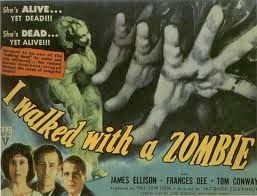
This chapter will explore the history and social significance of Haitian zombies and how those customs and practices instill a sense of fear in Western culture. By looking at films such as White Zombie, I Walked with a Zombie, and The Serpent and the Rainbow, this chapter will look at the human fear of losing control of their own mind and how “exotic” societies and their practices make us uncomfortable and fearful.

Chapter 3: Zombies from Space
Space is still a strange and unknown area. Before the space program kicked off and sent astronauts and probes to discover what was out there, only the limits of the imagination could explain what existed in the vastness. Scary and harmful things could be up there and come to Earth. What if in our explorations we discover something long dormant that wants to kill us? Worse yet, what if those things wake the dead? This chapter will explore the fear of the undead coming from space by looking at films such as Night of the Living Dead and Ghosts of Mars.

Chapter 4: Playing God
Science has given us a lot of advancements. They have worked hard to eradicate disease and improve the quality of life through the foods we eat and the medicine we take. It’s possible they have even searched for a way to defeat death. But are these things science should be messing around with? Should they have the ability to genetically modify food, even if it improves nutrition and sustainability? Is it possible that these advancements will mess with the natural order and create havoc with evolution? This chapter will look at the fears associated with science play God and how frightening it can be if their creations get out of hand.

Chapter 5: Pandemic Zombies
There was a time when plagues would wipe out the vast majority of the population. Until science understood the nature of pathogens, humans were at the mercy of the tiny germs. There are still outbreaks, so is there a chance another pandemic could occur? This chapter will look at the history of deadly outbreaks, how they have been combated, and the various ways an epidemic can infect a population.

Chapter 6: Zombies and Water
Water is vital to the survival of the human race. After oxygen, it is the most important element we need to live. It is also vital to the survival of pathogens, and many of them live and infect the water supply. In an industrialized society, we are fortunate to have treatment plants that ensure clean water always reaches our tap, but what if something goes wrong? Communities have been infected through the water supply before. What happens when society no longer exists? How will we be able to get clean water to survive?

This chapter examines the possibility of the zombie outbreak occurring through the water supply and what can be done to combat it. Using films such as Land of the Dead and the TV series The Walking Dead, this chapter also looks at how our society is “civilized” through treatment plants and what we would need to do to survive if they no longer existed.

Chapter 7: Biological Warfare Zombies
A pandemic outbreak of disease is scary enough, but it’s downright frightening to know someone developed and unleashed the disease on an unsuspecting population. While this type of outbreak hasn’t yet occurred, the threat of it happening is very real. This chapter will look at how science can be responsible for destroying the world with a developed biological disease that is used as a weapon.

Chapter 8: Surviving the Zompocalypse
Using various examples from films, this chapter will look at ways in which humans can survive the zombie uprising.

Friday, March 21, 2014

Zombie Nonfiction Progress

When I started this project eight months ago, I didn't really know what I was getting myself into.  I knew it was going to be a lot of work, but it was a subject that interests me, so it was worth it to me.  There was the chance that no one would want to publish it.  Technically, this last statement is still true since I haven't received any offers, but I remain optimistic that someone somewhere will put this baby into the world (even if that someone is me).

As of now, I have one chapter left to write.  It's a really fantastic feeling.  I can't believe it's almost done.  There's still a lot of editing that needs to occur, but the hard part is almost finished.  The text is going to be on the page.  What a sense of accomplishment!

Friday, March 14, 2014

Zombies Are So Depressing

Last weekend, I finished chapter 8 of my nonfiction zombie project, which looks at ways in which humans can survive the zombie apocalypse.  Turns out, we probably won't.  

Now, don't get me wrong, I understand that zombies are HORROR and they aren't supposed to paint a pretty picture.  They're supposed to be scary.  But my point is, there are several other horror films out there that are scary but have a small kernel of hope in them.  Since I'm well versed in slasher films, those are the examples I'm going to use.


Slasher killers are out to kill.  That's their only motivation for living.  But at the same time, they don't completely destroy the world, and there is a tiny bit of hope that they can actually be defeated.  Sure, they come back, but at least the Final Girl has her moment of triumph (no matter how short lived it is).

We don't get moments of triumphs with zombies.  We can win small battles and survive for another day, but the entire world has been destroyed.  Slasher killers inhabit one small part of the planet, so if you don't want to be hunted by them, you move to another area.  Zombies are everywhere.  There's no hope in destroying them completely.  As long as there are humans, there's the threat that they will exist.

Film after film after film portrays this depressing destruction.  There is absolutely no hope for the humans because not only do they have to fight the undead, they are constantly warring among themselves.  I'm guilty of portraying this situation myself.  In my YA books, I focus on the horrible things humans and zombies do with very little chance of redemption, but I also wrote a novelette that I think is full of hope (you can find it here).


The lack of hope and salvation starts to get to you after a while.  You want the humans to pull their heads out and figure out what it means to be nice.  You want them to be happy.  You want them to defeat the zombies.

But that's the point.  The films show how bad we as humans can get.  They show how destructive and evil we can be.  Thankfully, not every single one of them is fatalistic, there are a few that offer up hope, including Warm Bodies and maybe the ending of Land of the Dead, but most of them follow the incredibly depressing, humans are screwed formula.

I'm not saying they should change their format.  I'm a huge fan of zombie films and their traditions.  I'm merely pointing out my observation.  But if they want to change, maybe they could add just a touch more optimism into their story lines.

Friday, February 7, 2014

Zombie Makeovers

There is a trend in the movie industry to convert old films into DVD format.  It’s a great trend; it allows new audiences to enjoy the classics and old audiences a way to watch their favorites.  When they convert them into this new format, they usually also make them high definition, which can be both bad and good.

A lot of old horror films don’t really translate well into high definition.  Most of them didn’t have large budgets, so their special effects might have been a little cheesy.  When they are converted to high def, this cheesiness becomes readily apparent.  The film gets dated, and sometimes it’s hard to watch.

Not all films have this problem.  In fact, I recently rewatched Day of the Dead (which is one of my all-time favorite zombie films), and it had been converted to bluray.  It was amazing how well the special effects held up.  You have to hand it to Tom Savini, he really knew what he was doing.


 The blood, gore, and intestines looked fantastic on the screen.  The people were torn apart and it looked horrifically real.  It was what a zombie film was supposed to be.  It was so very exciting to watch.


I don’t mind CGI effects, they’re fine.  They’re part of the evolution of film making.  But there is something to be said for “the old way” with mannequins and gallons of red dye and probably entrails from the butcher shop.  Adds a sense of realism to the film.

Friday, January 31, 2014

Shambling Along

Last weekend, I finished chapter 4 of the nonfiction zombie book.  I now have chapters 1-4 and chapter 6 done.  It feels really good.

The next section of the book I need to work on is the part I've kind of been dreading.  It's the part about pandemics and the nature of bacteria and viruses.  I'm sure it will be fine once I get going, but I have to do some research before I can move forward.  I've already started, and I will keep going, but it will slow things down a bit.  I'm thinking I need to change the chapter layout.

This book is really starting to take shape.  I'm excited about the progress I've made, but I still have a lot of work left to do.

Friday, January 24, 2014

Gospel of the Living Dead

My research has led me to my friend Kim Paffentroth's book, Gospel of the Living Dead.


In it, he uses theology and Dante's Inferno to critique George Romero's zombie films.  It's incredibly fascinating.  So far, the thought that has stuck with me is this:

"It is not bad enough for our band of survivors that they are surrounded by walking corpses who will never go away until they have torn the humans limb from limb and eaten them alive, for on top of this threat, the humans constantly fight amongst themselves.  Without heroic qualities or virtues, our human protagonists are as much a threat to one another as the living dead are to them." (pg. 32).

He is referring to Night of the Living Dead in this passage, but it really applies to any zombie film.  I've always had a vague notion of how the characters interact with one another in the films, constantly fighting both themselves and the zombies, but it never really occurred to me how prominent the in-fighting was until after reading this.  It's almost ridiculous how the humans interact with one another.  And it's not just in Romero's films.  A lot of other zombie flicks also employ this technique.

Now, I realize that humans don't always get along with one another.  But at the same time, a crisis or disaster usually brings out the best in people.  Earthquakes, hurricanes, typhoons, bombings, they all bring people together to work for a cause and help our fellow human beings.  Yet when it comes to zombies, we are ready to tear each other's throats out.  It's interesting.

Granted, the point of the films is to show how destructive we humans are and how we aren't that much different from the walking dead.  There is a thin line between us and the undead.  We are primal and driven by base desires.  The only difference between us and the zombies is that we have the ability to make a conscious choice not to act like that.  But how often do we make it?


Friday, December 6, 2013

Favorite Zombie Movies

There is an array of zombie movies out there.  Classics, contemporary, gory, art house, cheesy, thought provoking.  You name it, they’ve probably made it.  The only thing they all have in common is the stars:  zombies.  And who doesn’t love a zombie?

There’s no possible way I could watch all the zombie films that have ever been made, but I will be watching quite a few for my research.  Heck, even without having to do research I’ve watched quite a few zombie flicks.  I really enjoy the genre, so it doesn’t take much convincing for me to see one.  

I’ve seen some really good films, and some really bad films.  At this point in time, there has been only one zombie movie I’ve never finished, and that was some movie where a fast food chicken place was built over an Indian burial ground and people who ate the chicken were turned into zombies.  I can’t remember the name, but it was horrible!  Horrible, I tell you!  And it has to be pretty bad for me to turn it off.  I watched Strippers vs. Zombies all the way through.


Still, there are some really exceptional zombie films out there, and I have a long list of favorites, including:  all of the Evil Dead films, Dead Snow, World War Z, and, of course, the Romero films, with Night of the Living Dead being my favorite, and Day of the Dead falling in right behind it.


What are some of your favorite zombie films?

Friday, November 22, 2013

Classic Zombies

Over the weekend, as part of my research, I rewatched White Zombie and watched I Walked With a Zombie for the first time.  They both had their moments.  The stories were interesting and said a lot about the time frame they were made in. 

Some of the cuts and transitions in White Zombie were weird.  I’m fairly certain they cut out a part that they didn’t mean to cut out.  Or maybe that just happened when the film was transferred onto Netflix.  The sound had some issues too, but this film was from 1932, I wasn’t expecting perfection.

 (Interesting footnote: author Stephen Sullivan recently completed a new White Zombie novelization and script based on the original film. )


I Walked With a Zombie was fairly interesting.  It amazed me that in 10 years, film quality could improve so much.  Again, the film dealt with Haitian zombies and people being turned against their will. 


For the research I’m doing, both of these films are incredibly important, but they’re also important for the zombie genre on the whole.  It’s fun to see how zombies evolve through time and how our fears of them change.  If you’ve never seen these movies, I recommend giving them a try.  White Zombie is only an hour long, and I Walked With a Zombie a little over an hour, so you’re not giving up too much of your time. 


Like I said, I enjoyed them for what they are, and I have a weird crush on Bela Lugosi, but only when he has a goatee!


Friday, November 8, 2013

The Walking Dead

As I progress further into my research for the nonfiction zombie book, I can’t procrastinate watching The Walking Dead anymore.  I attempted to watch the series when it first came out and got maybe halfway through season 2 before I stopped.  I couldn’t stand the characters.  How did such idiots survive the zombie apocalypse?  Why were they still surviving?

The scene where Lori goes into the field to pee on a pregnancy test instead of going into the bathroom and locking the door sealed it for me.  It also drove me insane that Dale insisted on keeping his camper, which was held together with duct tape and luck, because it held sentimental value.  I’m pretty sure when survival is at stake, sentimental value goes out the window.  Park it in your driveway and make it your goal to come back to it one day.  Until then, get something reliable that’s actually going to help your cause.

As I come back and watch the series now, I’m convinced the characters are insufferable for a reason.  This is a very emotional time.  The world has just ended, corpses are walking around on the streets.  The survivors are trying to figure out what’s going on, but they are also trying to hold on to their humanity.

Zombies bear a striking resemblance to us, but they lack emotions.  And that’s the point.  They are supposed to make us reflect on our lives and figure out what it is about us that makes us human.  The Walking Dead attempts to do that.  It shows us the characters overreacting to situations, being extremely emotional, because they are different from the flesh-eating, unfeeling corpses hunting them. 

There is also a sense that the characters are common and therefore flawed.  It’s very easy for me to yell at the TV screen about how I would do things differently, but I’ve never been in that situation before.  I don’t really know how I would react.  Not everyone in the world is going to have the skill set to be rugged survivalist, but the point is they don’t have to be.  Each character in the series brings something helpful and maybe unexpected to the group to ensure survival.   

The most important thing to look at while I’m watching The Walking Dead is how do the characters grow?  Every character has to grow and change, it’s part of their story.  If they can’t or don't, that’s when they end up dead.  While I still cringe slightly when I think about watching the series, I’m also excited to look at it through different eyes. 


Thursday, October 17, 2013

Neeta Lyffe, Zombie Exterminator: Meet the Zombie Extermination Research and Development Center


Neeta Lyffe, Zombie Exterminator looks at the zombie apocalypse in a different way--as fodder for a reality TV show, Zombie Death Extreme. It was such fun to build this world gone mad, but not in a World War Z way.  Instead, we have a limited number of undead, but unlimited number of bizarre reactions to the undead, from conspiracy theories concerning their origins to new occupations, like zombie exterminators, to exploitative television shows.  Among all of them, are the scientists who seek a cure, the origin, and in the meantime, better ways to kill them.

Enter the Zombie Extermination Research and Development Center, also known as ZERD.  A minor player in the Neeta Lyffe novels, ZERD looks for the best ways to re-kill the shambling undead.  It's a thankless job, and an unpopular one at that.  So, when they had a chance to get a little bit of an image-bump by hosting an episode of Zombie Death Extreme, they jumped at the chance.  Of course, nothing touched by Hollywood Prime Time really reveals its true image.  Ah, but you'll see...


The Zombie Extermination Research and Development Center looked like any off-campus lab building: large, square, with pastel brick and tinted windows, positioned off the highway and surrounded by a large xeriscaped campus with the mountains in the background.  Not until one approached the entrance did the building's purpose make itself known and then only by a small, nondescript logo of the initials ZERD.
The Zombie Death Extreme viewers saw, however, an imposing military complex of cement blocks and steel, surrounded by six-foot fences topped with concertina wire and lined with surveillance cameras. 
This suited the employees of ZERD just fine.
Inside, Neeta, her plebes, two cameramen, and a somewhat green but determined staff writer followed their tour guide through another set of double doors.  The rubber waders they wore over their clean room suits squeaked on the tile floor.  Roscoe somehow managed to walk without squelching.  They passed rows of people working at computers and microscopes, their backs to the tour group.  With their white jumpers and caps, they looked ominous and official.  They didn't need to wear clean suits in this area, but no one wanted to go to get thrown out of the PTA or Rotary club because they'd been identified on Zombie Death Extreme.  East Palm Desert, after all, prided itself on its standards, and zombie work did not meet those standards.
Dr.  Corriander Spice, who insisted everyone call him Dr.  Hansen for the show, waited until they had all gathered around the large plate-glass windows, currently darkened.  They couldn't avoid filming him, but the producer had agreed to use a computer-generated avatar in his place.  As such, he was conducting the tour wearing a green-screen leotard with motion sensors dotting its surface.  He tried very hard to ignore the giggles of his workmates and to keep his stomach sucked in.  At least the director had agreed to replace him with a likeness of Duane Jones.  He'd always harbored a secret longing to be just like the hero of Night of the Living Dead.
"So, to recap: We've seen the vivisection room--feeling better now, Gary?--and we've learned that removing appendages and even evisceration will not do more than slow your zombie down."
"Gawd, yes!  The way that legless one kept crawling on, groaning, 'Flesh wound!  Flesh wound!' was just too creepy." Roscoe interjected.
Gary placed a hand over his mouth and his cheeks puffed.  LaCenta rolled her eyes at him.
Spice wanted to ask him if he needed another bag, but the director had already chided him several times about talking to anyone but Neeta, the plebes, and the camera.  He couldn't help it; the kid looked so pitiful!  He decided to distract him instead.
"'Creep' is just the word!" Spice laughed, and Neeta chortled, but the rest looked blank.  "Sorry.  Exterminator humor.  You'll learn it.  So the lesson there is, sever the upper spinal column, or..."
He held up his hands like a conductor.
The group chanted, "When the head comes away from the neck, then it's over."
He clapped his hands together.  "Exactly!  And, in fact, federal law now requires that all dead have their spines surgically severed before burial.  Now, I know Neeta loves her chainsaw, but really, flamethrowers are the most effective destructive tool in your kit.  Embalming fluid is highly flammable, especially where older corpses in advanced stages of decay are concerned."
Neeta growled, "Which is all well and good until you singe some lawyer's precious back porch."
"Just so," Spice said.  "There are too many places where napalm and fuel-injected inferno just don't fit."
"No truer words," Roscoe crooned.  LaCenta slugged him.
"Not to mention the fact that a flamethrower in every home really isn't the best of ideas.  So, we at ZERD are exploring safer means not only of extermination but of protection.  We have been doing some very exciting work with antihistamine foam."
Gordon snorted.  "Allergy meds for zombies?  You've got to be kidding me."
Spice grinned at him.  "Watch." He pressed a button on the wall.
The windows cleared to show a large room empty except for various mechanical arms suspended from the high ceiling, bearing a variety of spray nozzles and hoses.  On one end, a small tray holding a pound of ground beef slid out of the wall.  On the other, a door opened, and a female zombie clad in the ragged remains of a filthy calico dress staggered into the room.  She hesitated, her head jerking about as she took in her surroundings, then she staggered for the meat.
About halfway across the room, a sprayer whirred into action, coating a line of foam between her and the meat.  She jerked to a stop, wavering, her groans growing into panther-like screams.
"You trained it," Gordon scoffed.
"You can't train a zombie," Spice countered.  "The part of the mind that processes cause and effect is atrophied.  There's not even enough left for a Pavlovian effect."
As the zombie paced the line, screeching with frustration, Spice continued.  "We aren't ready to deploy this tool yet, unfortunately.  The concentration of antihistamine is way beyond FDA tolerance levels.  Unless the exterminator is wearing a full haz-mat suit, including gas mask, she or he will experience dry nose and mouth, irritability, and, of course, drowsiness, which is a bad thing when dealing with the undead--and of course, no one exposed should drive or operate heavy machinery for four hours afterward."
The zombie had started to calm and poke at the foam with her toe.
"Unfortunately, as you can see, the effect does wear off as the foam disintegrates.  It's not ready as a long-term preventative until we find an agent that releases the chemical slowly.  However..." He pressed another button.
The mechanical arm whirled toward the zombie and hosed it down with pinkish foam.  The zombie's hunger screams rose into panic and it flailed at the stream.  It staggered back, clawing off its own face, until it collapsed on the ground, jerked once, and stilled.
"It's going to stay down?" Gordon asked skeptically.
Spice looked away from the prone corpse to answer, but saw Gary's pale face.  "You okay, there, Gary?"
Gary's eyes rolled into the back of his head and he collapsed.
"Cut!" Dave snarled as everyone gathered around the unconscious writer.